Nature
How to Start a Backyard Bird List: A Beginner's Guide to 20 Common Species
Most bird lists start by accident. Something small and yellow lands on the feeder, you squint at it, and then you spend twenty minutes trying to match it to a photograph. That moment — noticing, then naming — is the whole hobby in miniature.
A backyard list is just a running record of what you've seen and heard where you live. No travel, no expensive optics, no biology degree. You need a window, a notebook, and a willingness to look at the same ten feet of yard more carefully than you ever have before. Start in whatever season you happen to be in. The list grows faster than you'd expect.
What You Actually Need
You can begin today with your eyes and a pencil. Everything else is optional, and you can add it slowly.
- Binoculars, eventually. 8x42 is the size most birders settle on because it balances magnification, brightness, and weight. Borrow a pair before you buy, or use the ones in the hall closet. Cheap binoculars you actually carry beat excellent ones on a shelf.
- A notebook or index card. Whatever you'll keep nearby. A small pad by the window beats an elaborate journal you never open.
- A field guide or identification app. A regional guide is easier to use than a continent-wide one. Apps are handy because they can suggest species by size, color, and location.
- A chair facing the action. The plainest tool of all. Twenty quiet minutes in one spot teaches you more than an hour of walking around.
Four Questions That Name Almost Any Bird
How big is it? Compare it to a bird you already know: sparrow-sized, robin-sized, crow-sized. Size eliminates more wrong answers than color does.
What shape is it? Look at the bill and the tail. A short, cone-shaped bill means seeds; a thin, pointed one means insects or nectar. A long, notched tail tells you it isn't a finch.
What is the pattern? Notice markings, not just colors: a black cap, a white eyebrow stripe, a spot on the chest, a flash of red at the shoulder. Lighting changes color; patterns hold up.
What is it doing, and where? Hanging upside down on a trunk, hopping across the lawn, flying in a straight line high overhead, sitting on a wire. Behavior narrows the field fast.
Answer three of those four and you can usually open a guide and land within a page of the right bird. Write down what you saw before you look it up — the description is often more useful than the guess.
Twenty Birds to Learn First
These are among the most familiar backyard and feeder birds across much of North America. Learn these and you'll recognize most of your regulars by the end of a season.
- Northern Cardinal — crested, rich red or warm buff-brown, sharp metallic chip note
- Blue Jay — blue with a crest, loud and unapologetic
- American Robin — orange breast, runs and stops across open lawn
- Mourning Dove — plump, pointed tail, soft drawn-out cooing
- House Finch — brown and streaky, red wash on head and chest
- American Goldfinch — bright yellow with black cap and wings in summer
- Black-capped Chickadee — black cap and bib, white cheeks, fearless at feeders
- Tufted Titmouse — soft gray, small crest, large dark eye
- Downy Woodpecker — smallest woodpecker, short bill, checkered wings
- Red-bellied Woodpecker — laddered back, red nape, often on suet
- White-breasted Nuthatch — walks headfirst down tree trunks
- House Sparrow — chunky brown, gray crown, black bib on males
- European Starling — dark and speckled, yellow bill, walks instead of hops
- Common Grackle — long tail, glossy iridescent head, pale eye
- American Crow — large, all black, steady caw
- Dark-eyed Junco — the gray-and-white "snowbird" of winter
- White-throated Sparrow — white throat, yellow patch before the eye
- Song Sparrow — streaky brown with a dark central chest spot
- Red-winged Blackbird — black with red-and-yellow shoulder patches
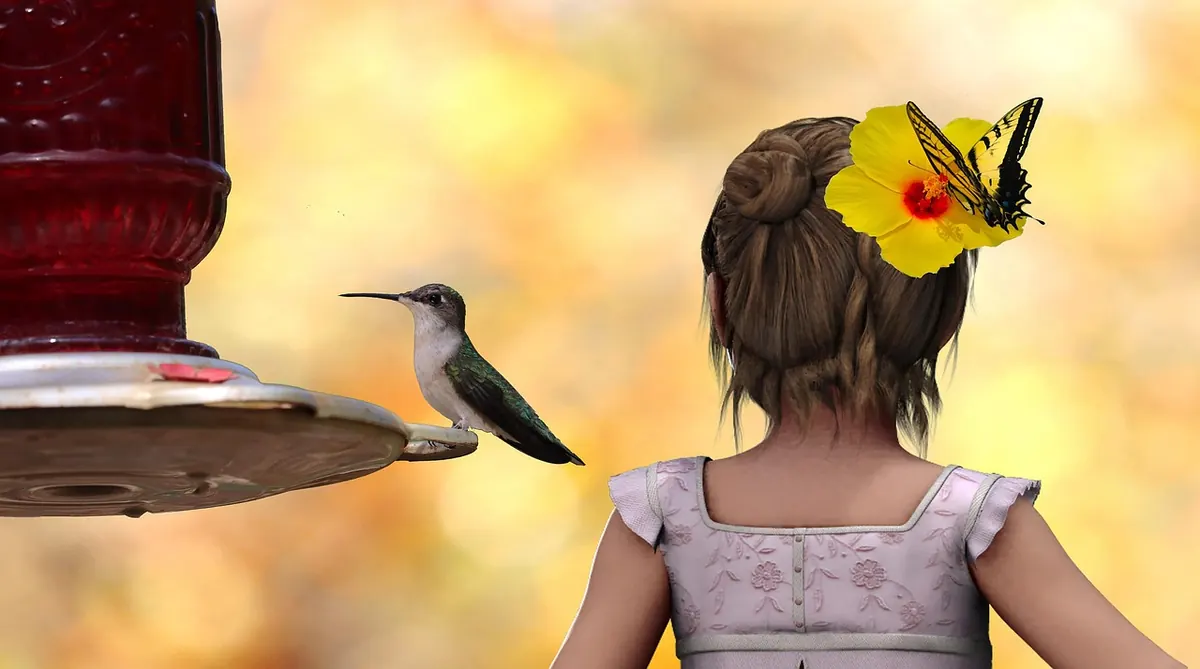
- Ruby-throated Hummingbird — hovering, tiny, drawn to red flowers and sugar water
Don't try to absorb all twenty at once. Pick three you see regularly this week and learn them properly — shape, sound, habits. Confidence builds faster that way.
Listening Is Half the List
On a spring morning you'll hear far more birds than you'll see. Learning a few songs doubles the size of your list without moving your chair.
Some songs come with handy phrases. The chickadee whistles a two-note fee-bee. The robin sings a cheerful rising run that many people hear as "cheer-up, cheer-a-lee." The tufted titmouse repeats "Peter, Peter, Peter." The white-throated sparrow sounds like "Oh sweet Canada, Canada, Canada." These mnemonics are personal — yours may be better than anyone else's, and that's fine.
Start with three sounds: the cardinal's clear whistled "birdie, birdie, birdie," the mourning dove's lazy coo, and the blue jay's jeering call. Those three cover a surprising share of ordinary backyard noise. Once a song has a name attached, you'll hear it every day.
Keeping the Record Simple
A useful entry takes thirty seconds. Write the date, the time, the weather, what you saw, roughly how many, and anything odd. Counts matter more than you'd think: two goldfinches in November is a different observation than twenty in April.
March 14, 7:10 a.m. Clear, 42°F. Two chickadees on the suet, one cardinal singing from the maple, five juncos under the feeder. First grackle of the year.
If you'd rather type than write, free tools such as eBird and Merlin let you log sightings by date and place, and they'll show you what others are reporting nearby. A paper notebook is still worth keeping. There's real pleasure in flipping back through your own handwriting and seeing the first junco of the season arrive a week earlier than last year.
Make the Yard Worth Watching
You don't need a big property. A few changes turn a lawn into habitat:
- Add water. A shallow dish refreshed every couple of days attracts birds that never touch a feeder.
- Plant native species. Local trees, shrubs, and perennials feed local insects, which feed local birds.
- Layer the space. Tall trees, mid-height shrubs, and low ground cover give birds places to perch, hide, and nest.
- Leave some mess. Seed heads, a brush pile, and a few fallen leaves are cover and food, not clutter.
- Clean feeders regularly. Scrub them every couple of weeks and more often in wet weather, and wash your hands after handling feeders or birds.
A Simple First Month Plan
- Put a notebook and pencil by the window you look out of most.
- Spend ten minutes a day watching, at the same time if you can manage it.
- Write down every bird you notice, even the boring ones you think you already know.
- Learn three species a week from the list above, one by sight and one by sound.
- At the end of the month, read back through your notes and tally the species you've recorded.
Let the List Grow on Its Own
There's no correct total, no schedule, and no penalty for leaving a bird unidentified. A backyard list is simply a record of paying attention, and attention is the entire reward. Keep the notebook where you can reach it, keep the binoculars by the door, and glance out the window when the light changes. Something new will show up. When it does, you'll already know how to look.
Photo: GeorgeB2 / Pixabay
Related Articles